Reading Law
Two young men, one body of law, and two very different doors.
Liam Gatlin and Isaac learned their letters at the same table in a Carolina schoolroom. Isaac was always the quicker of the two, though he had to sit in the corner and keep it hidden. Years later, both of them set out to study law. They read many of the same books. What the law would let each of them do with those books was another matter entirely.
Two Roads to the Same Books
| Liam | Isaac |
Where | Yale’s law school, New Haven | A lawyer’s office on Washington Street, Boston, and a table at home |
Teacher | Professors who lecture to a room of young gentlemen | Nathaniel Wardwell, one of the few Black attorneys in the country |
Books | Blackstone and Kent | Blackstone, then Kent, then pleading, on loan, returned in the condition they went out in |
How | Lectures, recitations, and evenings of reading | Reading alone at night, written questions, and answers that are not graded gently |
At the end | A degree, and a place at the bar | No place at the Connecticut bar at all |
Liam at Yale
In 1853 Yale’s law school was nothing like the institution it is today. It was small and struggling, run by a pair of New Haven lawyers who taught in rented rooms downtown. One of them was a former governor of Connecticut. Its students had been receiving Yale degrees only since 1843.
Liam arrives late to his first term and can’t keep up. Isaac quietly copies out the week’s lecture notes in his own clear hand. In his rooms by lamplight, Liam works through Blackstone’s Commentaries and Kent’s Commentaries on American Law, the foundations of every American lawyer’s training. He finds out what the law he is studying actually says about the man who lives with him.
“Isaac would not be permitted to speak.”
That is the Fugitive Slave Act of 1850, which barred a person accused of escaping from testifying at his own hearing. Liam is learning to join the profession that built the machine, and Isaac is still caught in it.
The school had its own history with that question. David Daggett, one of its founders, led the 1831 fight that killed a proposed college for Black students in New Haven. Two years later, as a judge in the Prudence Crandall trial, he told the jury that free Black people were not citizens of the United States.

Isaac Reads Law
Most American lawyers of the time never went to a law school. They “read law”: they apprenticed themselves to a practicing attorney, studied his books, copied his documents, and presented themselves for examination when he judged them ready. Yale’s own school had grown out of exactly that kind of law office.
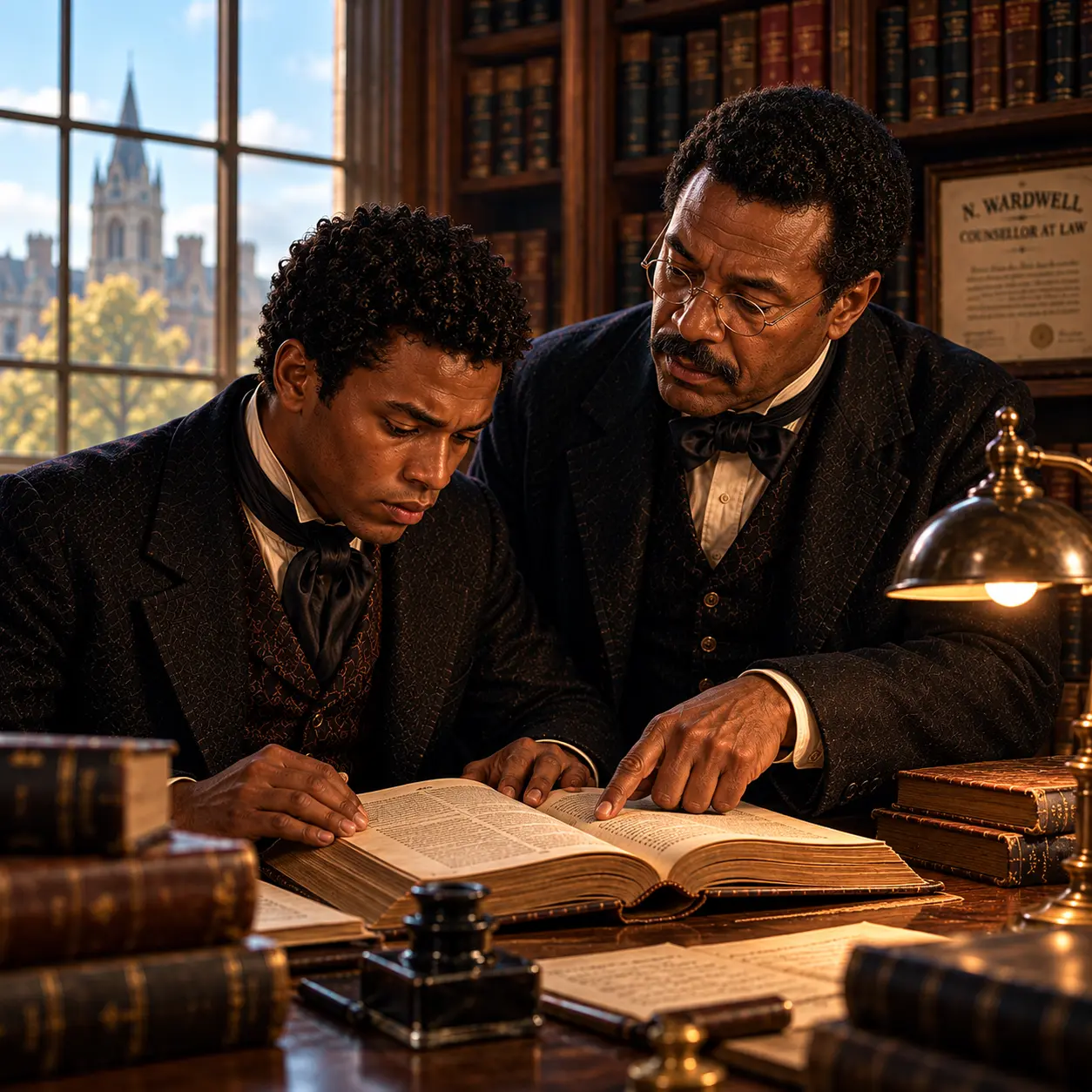
When Isaac’s own road to the law finally opens, late in the book, it leads to Boston, to a second-floor office above a stationer’s, and to Nathaniel Wardwell. Wardwell is fifty or near it, licensed in Massachusetts, and not inclined to be warm. He tests Isaac by handing him law books and asking him to explain what they say. Then he lays out the terms: Blackstone first, all of it, then Kent, then pleading. He also corrects Isaac’s habit of deference on the spot.
“Don’t yes sir me, I’m not your master.”
The harder lesson comes next. Connecticut has never admitted a Black lawyer. No statute forbids it. Instead, as Wardwell explains, a committee of gentlemen examines every candidate’s “character and fitness,” and
“they will find you unfit, and they will not write down why.”
Massachusetts is different. A door has opened there, barely, in the last ten years, and Wardwell has been through it.
The Same Books, Read Harder
Liam will walk into a lecture hall every morning, sit down, and at the end of three years be handed a degree he will have earned. Isaac will read the same books alone, at night, out of borrowed volumes, with no promise of anything at the end. The boy who once learned to read upside down from across a schoolroom table is still doing it the hard way.
Fact and Fiction
Liam, Isaac, and Nathaniel Wardwell are invented. The history around them is real:
- Yale’s law school grew out of a New Haven law office. Its students first received Yale degrees in 1843, and for decades it was a small proprietary school that the university nearly closed more than once.
- David Daggett, a co-proprietor of the school, led the 1831 opposition to a college for Black students in New Haven and presided over the 1833 Prudence Crandall trial.
- Macon Bolling Allen became the first Black man licensed to practice law in the United States, in Maine in 1844, after first being refused on the ground that he was not a citizen. He was admitted to the Massachusetts bar in May 1845.
- Robert Morris was admitted to the Massachusetts bar in 1847 and argued Roberts v. City of Boston, the first court challenge to segregated public schools.
- Edwin Archer Randolph became the first Black graduate of Yale Law School and the first Black lawyer admitted to the Connecticut bar, in 1880, twenty-five years after the events of the novel.