The Journey North
Six days, eight railroads, and one folded piece of paper.
Introduction
In the last week of September 1853, Liam Gatlin left North Carolina to study law at Yale. Isaac went with him.
On paper, Isaac traveled as Liam’s servant—the property of Liam’s father, carrying a pass that said so. For years the two of them had imagined going north together. Neither had imagined that the road itself would pull them apart.
“A gentleman traveled in the cars; a gentleman’s man traveled where he was put.”
From Wilmington, Liam rode forward in the passenger coach, with windows and a stove. Isaac rode at the back, on a plank bench among the trunks and mail sacks. That was how they crossed seven hundred miles of the country.

There Was No Train to New York
In 1853 you couldn’t buy one ticket from North Carolina to Connecticut. The East Coast was stitched together from a chain of separate railroad companies, each with its own cars, stations, and schedules. Between them, travelers changed trains, waited in depot yards, crossed cities by horse-drawn car, and boarded steamboats and ferries where no bridge yet existed.
The trip from Wilmington to New Haven took about six days. For a white traveler it meant tiredness and delays. For a Black traveler, every change of trains meant a new platform, new strangers, and new chances to be stopped and questioned.
The Paper in His Coat
Isaac carried a pass written in Liam’s hand and signed in his father’s name. It described him, said where he was going and why, and named the man who owned him.
In the slave states, a Black man traveling without papers could be held as a runaway. Even with papers, he was at the mercy of whoever chose to read them. A pass could be doubted. It could be taken. Isaac kept his folded small and close, and felt it against his chest the whole way.
He also kept another rule. He had spent his life hiding that he could read, and on the road he didn’t dare look at a timetable, a newspaper, or a station sign.
“So it travels, he thought. That’s useful to know.”
The Route, Stop by Stop
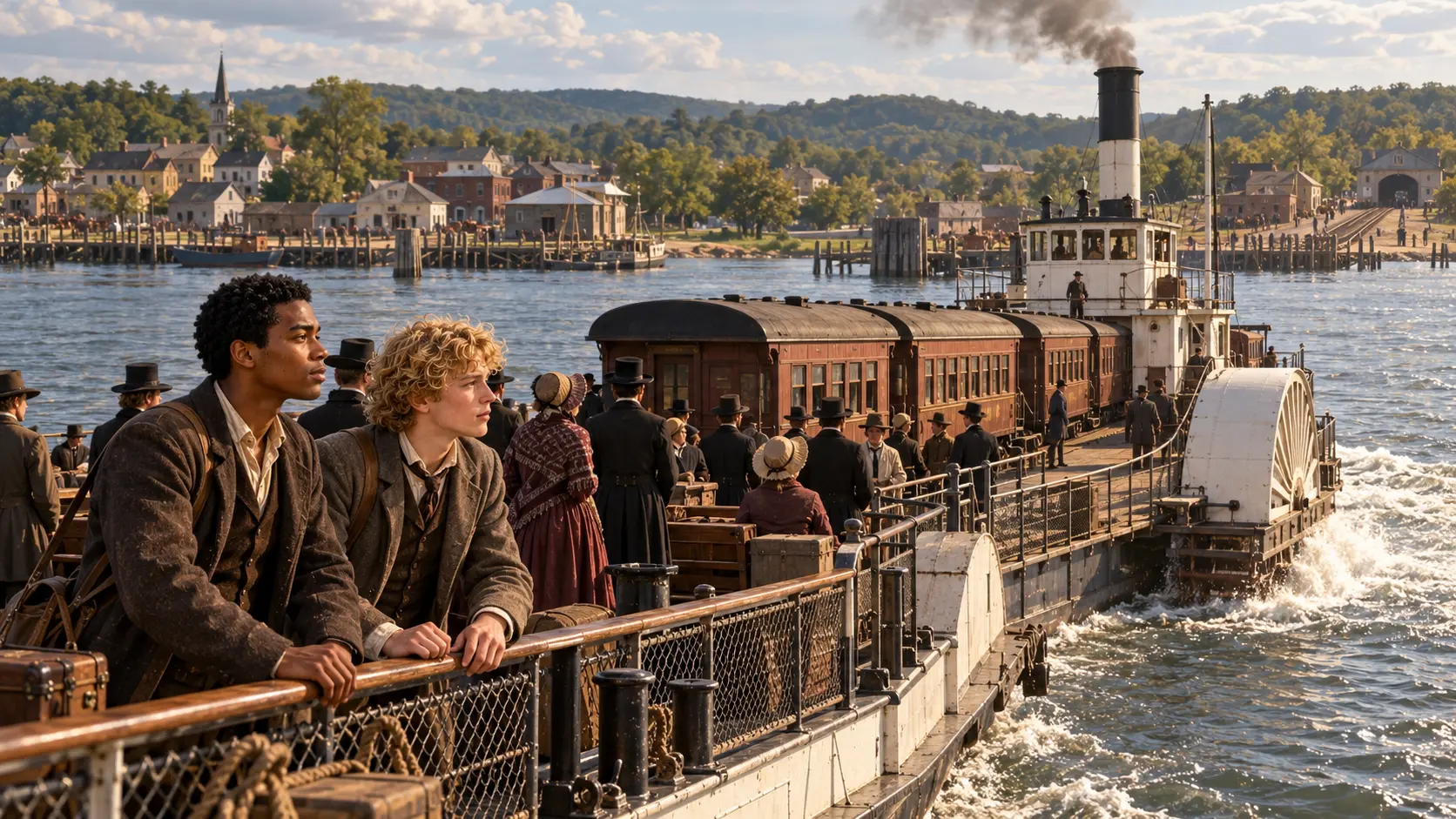
The Line That Wasn't There
For generations, people escaping slavery thought of the North as a place where they would be safe. The Fugitive Slave Act of 1850 changed that. It required officials and ordinary citizens in free states to help return people who had escaped. It denied the accused a jury trial, and it paid commissioners more for sending a person south than for setting him free.
By the time Isaac traveled north in 1853, crossing into a free state no longer meant what it once had. And Isaac wasn’t escaping. He was still, by law, William Gatlin’s property, wherever he stood.
The journey north is where Isaac learns how far that law reaches—and what freedom will actually take.

The Journey at a Glance
Day | Where | What happens |
1 | Wilmington → Weldon | The boys separate at the depot |
2 | Petersburg | A long wait in the rail yard |
2–3 | Richmond | An overnight stop, and Judith’s warning |
3–4 | Washington | By steamboat up the Potomac, then rail |
4 | Baltimore | Dusk at the depot |
4–5 | Havre de Grace → Philadelphia | The Susquehanna ferry |
6 | New York → New Haven | The end of the line |